

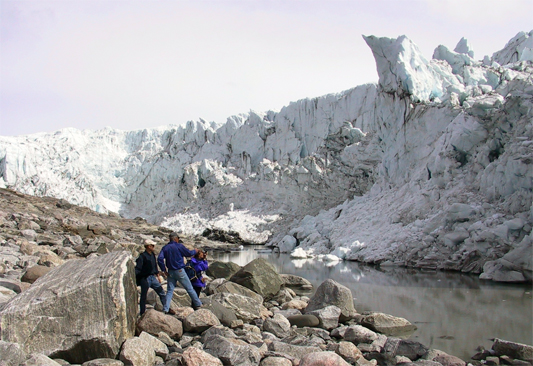
 Y van… ya no llevo la cuenta de las catástrofes anunciadas que no se cumplen y no se cumplirán previsiblemente. Recuerdan las noticias alarmantes sobre el progresivo derretimiento de los glaciares en Gronelandia? Sobre los peligros que un aumento de agua dulce procedente de esos glaciares supondría para las corrientes marinas en el atlántico norte? Para la propia Groenlandia? De lo inminente del asunto?
Pues parece que no sólo no ocurrirá mañana. Es posible que no esté ocurriendo en absoluto y que lo que observamos no sea más que fruto de la variación propia de los niveles de hielo en la isla correlacionada con las fluctuaciones climáticas normales del planeta:
One of the most vivid symbols of global warming used by scientists and campaigners to spur society to curb climate-warming emissions is photography of gushing rivers of meltwater plunging from the surface of Greenland’s ice sheet into the depths. Recent studies have shown these natural drainpipes, called moulins, can speed up the slow seaward march of the grinding ice by lubricating the interface with bedrock below. The faster that ice flows, the faster seas rise. Now, though, a new Dutch study of 17 years of satellite measurements of ice movement in western Greenland concludes that the speedup of the ice is a transient summertime phenomenon, with the overall yearly movement of the grinding glaciers not changing, and actually dropping slightly in some places, when measured over longer time spans. The work, the authors and other experts caution, does not mean that more widespread surface melting could not eventually destabilize vast areas of the world’s second-largest ice storehouse. But for the moment, the study, which is being published in Friday’s edition of the journal Science, throws into question the notion that abrupt ice losses in Greenland are nigh.
Y es que no hay como observar las cosas durante un tiempo prudente para darles el significado que realmente tienen. Por cierto, desde la sección de «ciencia» de el diario El Mundo, siguen empeñados en hacer propaganda catastrofista. No lo entiendo. O sí.





Me ha dado vd. el fin de semana, porque, como debe saber, yo estoy a favor del calentamiento global.
Es lo que comenta Carmelo en su blog. Las noticias se eligen bajo criterios… ay! los criteriossss
El mes que viene? No pueden. Las predicciones de esta gente sólo funcionan a 20 años vista, no les preguntes por la semana que viene, que no están ellos para esas banalidades.
Hoy en los informativos de antena 3 han dado la noticia de que el hielo del Ártico de derretirá y que será perfectamente navegable en pocos años…
Evidentemente este tipo de noticias impactan más al lector-espectador que la que nos traes, Luis, sensacionalismo puro y duro.
Por cierto, algún gurú de estos del cambio-calentamiento-enfriamiento climático-global me puede decir el tiempo que me va a hacer el mes que viene, es que me voy de vacaciones, por ver que ropa meto en la maleta…
Manin,
Por que no es noticia. El clima cambia, y las especies sobre la tierra también. Ya lo sabemos. No hay nada noticiable en ello.
Lo de Van de Wal en Science? Aquí. Siempre a tu disposición 🙂
No encuentro ese estudio en Science, si me puedes poner el enlace, mientras tanto te dejo otro estudio del que no has cometnado nada, ¿por qué será?
Climate Change Pushes Plants Out of Their Comfort Zone
By Lauren Cahoon
ScienceNOW Daily News
26 June 2008
Mountain ecosystems are experiencing a major mix-up in plant species, thanks to climate change. As Earth heats up the cool alpine temperatures, plant species have begun a slow-motion diaspora to escape, relocating upward an average of 29 meters per decade. With plant species migrating at different speeds, the entire makeup of mountainside communities is changing and potentially heading toward extinction, researchers conclude online today in Science.
Previous research has shown that alpine flora and fauna are especially vulnerable when it comes to global warming and that the upper and lower boundaries of populations’ home ranges have been moving higher up the mountain with every successive generation. Instead of focusing on those edges of a species range, Jonathan Lenoir, a plant ecologist at the Paris Institute of Technology in France, and colleagues decided to examine what climate change was doing to optimum ranges–the zones where most of a population lived–for plants in the mountain forests of western France. By analyzing species surveys that spanned a century, from 1905 to 2005, they were able to map the migration of 171 species.
The researchers found, overall, that the plants’ ideal ranges were moving upward and doing so quickly. This upward climb matched that of the temperatures in the French mountains–which have risen, more or less, by roughly 0.6°C in the 20th century–a much more dramatic increase than that of average worldwide temperatures. Furthermore, each kind of plant shifted its optimum range at a different pace: Strictly mountain-living species such as alpine wildflowers moved faster, whereas species that were able to live in lowland areas, such as the common juniper, were less hurried. Plants with shorter life cycles–such as grasses and herbs–also climbed quickly, leaving slow-maturing trees such as the silver fir to creep behind them. Such varied migration rates mean climate change is ripping apart the delicate connections between mountainside species, the team concludes.
This spells bad news for many mountain species, says Chris Thomas, a biologist at the University of York in the U.K. «The fact that you’re getting elevation shifts is symptomatic that some species might get pushed right off the top of the mountains,» Thomas says. «In some cases, that may mean localized extinctions–or it could mean complete extinction.»
Georg Grabherr, a plant ecologist at the University of Vienna in Austria who specializes in alpine plants, hadn’t expected the species to move so quickly over the decades. «I am somewhat surprised about the magnitude of [the plants’] shift,» he says. «These are forest plants, and forests are very resistant to migration.»
http://sciencenow.sciencemag.org/cgi/content/full/2008/626/3
¿El Mundo?
Pues uno tampoco lo entiende, pero entre la tontería climática, el demente de la Tronera y el elegante insultador Hidalgo, han perdido un lector.
De leer tres periódicos, en veinte años han conseguido que no compre ninguno.
Enhorabuena por la acidez.